
Random Thought Generators?
Thoughts on how randomness plays a role in our decision making

As a teenager I never questioned whether or not we had free will. To me, it was obvious that the world was purely deterministic, and given enough data we could predict what everything and everyone would do. Later on in college, I was confronted with quantum mechanics, and its seemingly irreducible random processes known as quantum indeterminacy.
To summarize to the best of my ability, the story goes like this : before a measurement is performed to know the state of a particle, its potential states are represented by the wave function. This probabilistic wave essentially describes the distribution you would expect after performing a measurement thousands of times, and how it changes over time. For example, under the same initial conditions, you might expect the particles to reveal themselves in state A 30% of the time, and in state B 70% of the time.

What is interesting, and counterintuitive to this process is that there does not seem to be an explanation for why a particle reveals itself in either state A or B. That is, there is no causal connection between the state of the particle prior and post measurement.
There are two main lines of interpretation to this : the Copenhagen interpretation, and the many-worlds interpretation. The former briefly asserts that the particle exists in both states simultaneously prior to measurement, and only collapses into a certain state once observed. The latter states that upon measurement the universe branches into two different realities, one where the particle reveals itself as A, and the other as B.
What I find fascinating about this is that neither of these interpretations can remove the fundamental randomness observed. The way I like to think about this is along the lines of : “there is no prior cause, no mechanism that makes the particle appear in either state”, it is a purely probabilistic occurrence. Whether the particle exists in two states simultaneously, or the universe splits in two, the consequences of the measurement still appear to be random.
You may object to this with a thought along the lines of: “just because we don’t know how it works, it doesn’t mean there isn’t an underlying cause”. If that is so, you are in good company. Albert Einstein argued that this randomness could not be fundamental. He famously wrote in a letter to Neils Bohr, “I, at any rate, am convinced that [God] does not throw dice”.
As you may have guessed, the question of fundamental randomness is still a matter of debate. Is this a limitation of our models? Or, can something truly be random? Perhaps this debate will be settled someday, but as it stands today the limits of our knowledge imply that we perceive randomness either way.
Indeed, even without relying on quantum mechanics, randomness plays a major role in our lives. As sometimes referred to as the “birth lottery”, we do not get to choose our genetic makeup, the time and place we are born, or the home environment we grow up in. Based on these factors, and the fact that we are only ever capable of learning about a subset of the world around us, I would go so far as to argue that we do not get to choose our interests, our values, or even our thoughts (I think anyone who has attempted meditation can attest to this).
Whether randomness is a limitation of our perception or part of fundamental reality, I am forced to consider whether or not free-will can be seen as a weighted random process. That is, are our decisions random? Are we random thought generators (RTGs) ? (Hey! That’s the name of the blog!)
With no intention of going into depth, for it is beyond my own subset of knowledge, I can think of three things that make me lean towards this belief : correlations between childhood experience and adult behavior, birds, and action potentials in the neurons.
I don’t think the correlation between childhood and adulthood is a mystery to anybody. Even before the scientific revolution, people were aware that they should “raise” their kids to develop certain skills, and often to think in certain ways (known today as indoctrination). This is basically the same as the birth lottery.
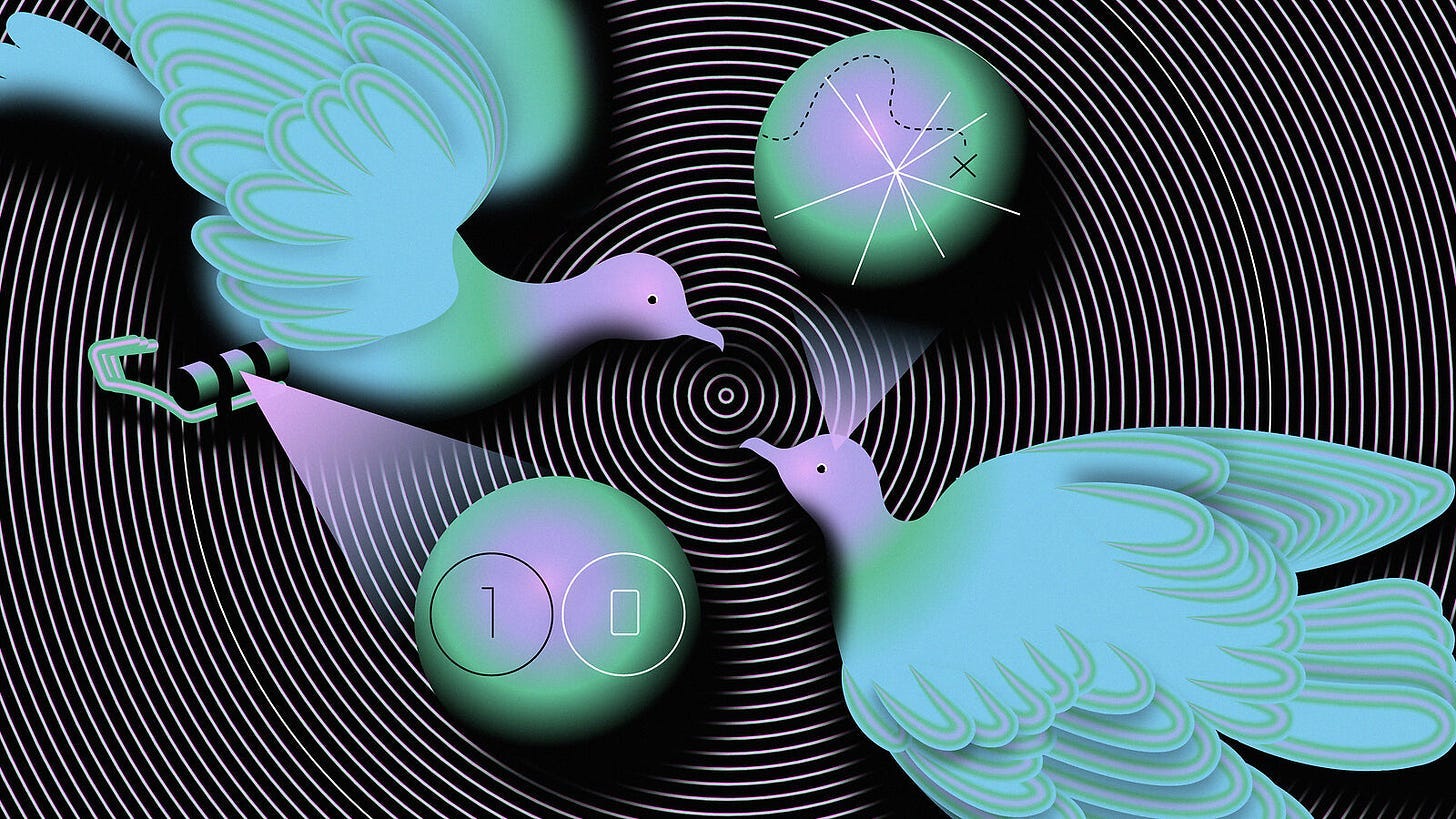
Amazingly, some migrating birds have been shown to make navigational decisions based on quantum entanglement. If it has been shown that quantum effects directly correlate to a sensory experience for the bird that will make it fly left or right, it opens an enormous path for exploration. I would find it hard to believe that the subatomic does not play any other part in decision making, and since the subatomic is governed by the randomness of quantum mechanics, it gives me good reason to consider it a possibility.
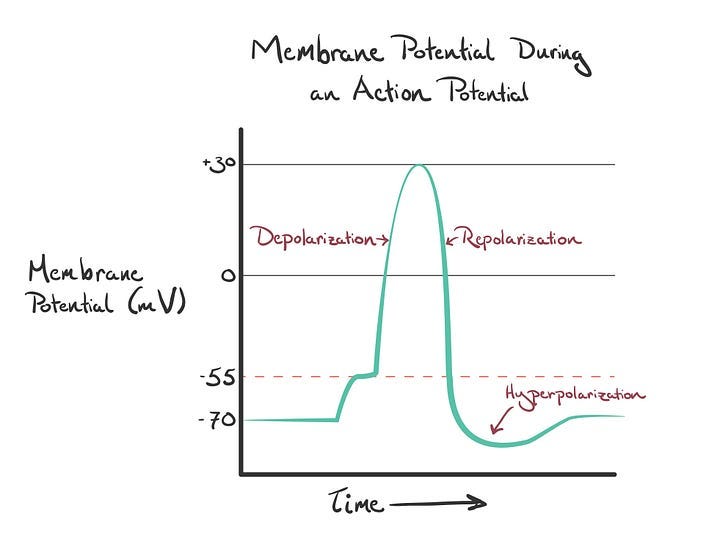
The idea behind action potential, which I first heard about from my sister, fits quite well the way I imagine a decision being made. In brief, neurons are interlinked to transmit information from one to another. Whether information is transmitted to the next neuron in the chain is determined by the electric potential created by the previous neuron. It essentially behaves like a capacitor, capable of building charge and releasing it all at once when the threshold is achieved.
Say I am hesitating on a decision with no real consequences, such as deciding between yellow or green pajamas for bed tonight. In my brain, two neural pathways are preparing themselves: one to grab the yellow, and one to grab the green pajamas. I imagine this in my brain as two capacitors preparing to initiate the action. The one that reaches the minimum burst charge will win out over the other one. Eventually, I say “Fuck it! Who cares!? ”, and go for the green one. If you were to ask me to justify my decision, I would be at a loss. The best I could do is describe this decision as random.
Using the capacitor analogy of decision making, let us now consider one that does have consequences. Say, preparing a meal for some guests, and one of them is allergic to peanuts. If I happen to know this, it will weigh in my decision. Unless I want to play a cruel trick, I would probably decide to opt for peanut-less pad thai (whatever that is). If I did not know this, the thought of allergic reactions may not even cross my mind. That bit of information effectively plays a role in which of the capacitors gets charged, without it my decision is purely random, with it it is weighted towards peanut-free meals.
The point being, it seems to me as though our thoughts and decisions, or rather, our free-will is immensely affected by random occurrences. If you are a forgetful person as I am, making good decisions can be extremely difficult. It requires holding many different considerations in working memory, and that is if you are lucky enough to have the most important pieces of information appear in your mind at the time of a decision.
That being said, acknowledging the random occurrences of the world out there, and within our minds does not eliminate the possibility of us having some real control. As it stands today, the question of free-will seems unfalsifiable. That is not to end the conversation, but it seems to me that this can be used to our advantage.
Psychological and anthropological studies have shown us that we are perfectly capable of holding contradictory beliefs simultaneously (see doublethink). Indeed, it seems that it is all too common within our minds. For example, we are capable of being worried about climate change, yet still drive to work everyday (guilty!). We may proclaim that everyone is unique and deserving to express their individuality, yet simultaneously judge those who do not go by our own social standards. There are many more examples, and I encourage you to think about some of your own. The point is, if we are capable of holding contradictory beliefs, why not use this to our advantage and filter out those that help and those that don’t.
Instead of finishing with unsolicited life advice, let us end this thought with some open questions, which I hope you will help me answer :
What are the costs and benefits of assuming…
That our decisions are random?
That our decisions are predetermined?
That our decisions are entirely in our control?
I hope you enjoyed the thought experiments, and hope to see you next time for some random thoughts !